Showing posts with label bangladesh. Show all posts

Monday, March 28, 2011

The Chosen One-Part2


Remembered: Nur Hossain


[Rezwan, Germany.]

Bangladeshi blogosphere observed November 10 as Nur Hossain day.

Banglapedia:

Hossain, (Shahid) Nur (1961-1987) a victim in a mass movement against Ershad-regime in 1987. Born in 1961 at Narinda in Dhaka Nur Hossain was the son of Mujibar Rahman, an auto-rickshaw driver, whose ancestral home was at village Jhatibunia under Mathbaria upazila of Pirozpur district.

His family had been living at 79/1 Banagram Road in Dhaka since liberation. Nur Hossain received his primary education from the Radhasundari Primary School at Banagram Road, and while a student of class VIII at Graduate High School in Dhaka, he left school and received training in motor driving. As an activist in politics he was the publicity secretary of the Banagram unit committee of Dhaka City Awami League.

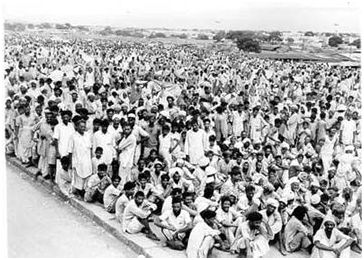
As a part of the long drawn movement against the autocratic rule of President Hussain Muhammad Ershad, the alliance of the opposition political parties declared ‘Dhaka Blockade’ programme on 10 November 1987. The aims and objectives of the programme were to realise the demands for resignation of Ershad government and holding of Jatiya Sangsad elections under a neutral caretaker government. Nur Hossain had his bare back and chest painted with the slogan ‘Sairachar nipat jak, Ganatantra mukti pak’ (Down with autocracy, let democracy be established). Looking so prominent in the crowd, Nur Hossain was shot dead by the police at the Zero-point in front of the General Post Office. The slogan imprinted on his body soon turned into the slogan of the irresistable mass movement which eventually led to the fall of the Ershad-government on 6 December 1990.

To commemorate his sacrifice in the struggle for the restoration of democracy in the country, the Zero-square in Dhaka city was renamed after him as Nur Hossain Square, and a postal stamp was issued in honour of his memorable sacrifice.

****************************************************************************

Nur Hossain (Bangla:নূর হোসেন) (1961-November 10, 1987) is perhaps the most widely known martyr in the movement in Bangladesh against the dictatorship of General Hossain Mohammad Ershad. Neither well-off nor highly educated, Nur Hossain embodied the struggle of common people of the country.

Nur Hossain was born in Narinda, Dhaka, in 1961. His father was an autorickshaw driver. Hossain had to quit school while in the eighth grade and got training as a motor driver. He was an activist of the opposition party Awami League.

On November 10, 1987, during the Dhaka Blockade program, Nur Hossain painted his chest and back with the slogans স্বৈরাচার নীপাত যাক, গণতন্ত্র মুক্তি পাক (transliterated as Sairachar nipat jak, Ganatantra mukti pak, translation: Down with autocracy, let democracy be established). He was shot dead by the police. A photograph of Nur Hossain showing his back taken shortly before his death, has become an important icon of the struggle for democracy in Bangladesh. Mass movements caused Hossain Mohammad Ershad to resign in December, 1990. Each year, November 10 is commemorated as the Shaheed Nur Hossain Dibosh or Martyr Nur Hossain Day in Bangladesh. Cultural and political organizations run special programs to observe the day.[1]


Sunday, October 18, 2009

Saturday, October 17, 2009

The Brain Of India


SECTION SIX
THE BRAIN OF INDIA

THE time has perhaps come for the Indian mind, long preoccupied with political and economic issues, for a widening of its horizon. Such a widening is especially necessary for Bengal.
The Bengali has always led and still leads the higher thought of India, because he has eminently the gifts which are most needed for the new race that has to arise. He has the emotion and imagination which is open to the great inspirations, the mighty heart-stirring ideas that move humanity when a great step forward has to be taken. He has the invaluable gift of thinking with the heart. He has, too, a subtle brain which is able with in certain limits to catch shades of meaning and delicacies of thought, both those the logic grasps and those which escape the mere logical intellect. Above all, he has in a greater degree than other races the yet undeveloped faculty of direct knowledge, latent in humanity and now to be evolved, which is above reason and imagination, the faculty which in Sri Ramakrishna, the supreme outcome of the race, dispensed with education and commanded any knowledge he desired easily and divinely. It is a faculty which now works irregularly in humanity, unrecognised and confused by the interference of the imagination, of the limited reason and of the old associations or samskāras stored in the memory of the race and the individual. It cannot be made a recognised and habitual agent except by the discipline which the ancient Indian sages formulated in the science of Yoga. But certain races have the function more evolved or more ready for evolution than the generality of mankind, and it is these that will lead in the future evolution. In addition, the race has a mighty will-power which comes from the long worship of Shakti and practice of the Tantra that has been a part of our culture for many centuries. No other people could have revolutionised its whole national character in a few years as Bengal has done. The Bengali has always worshipped the Divine Energy in her most terrible as well as in her most beautiful aspects; whether as the Beautiful or
Page – 327
the Terrible Mother he has never shrunk from her whether in fear or in awe. When the divine force flowed into him he has never feared to yield himself up to it and follow the infinite prompting, careless whither it led. As a reward he has become the most perfect ādhāra of Shakti, the most capable and swiftly sensitive and responsive receptacle of the Infinite Will and Energy the world now holds. Recently that Will and Energy has rushed into him and has been lifting him to the level of his future mission and destiny. He has now to learn the secret of drawing the Mother of Strength into himself and holding her there in a secure possession. That is why we have pointed to a religious and a spiritual awakening as the next necessity and the next in evitable development...READ MORE

Wednesday, August 5, 2009

The Tipaimukh Dam Controversy

As India and Bangladesh engage in a heated debate about an Indian-planned dam project, experts disagree about the consequences for Bangladeshi people and the environment, Animesh Roul reports for ISN Security Watch.
By Animesh Roul in New Delhi for ISN Security Watch..read more


Tipaimukh Dam Is A Geo-tectonic Blunder Of International Dimensions
By: Dr. Soibam Ibotombi (Dept. of Earth SciencesManipur University)
Introduction:The proposed Tipaimukh dam is to be located 500 metres downstream from the confluence of Barak and Tuivai rivers, and lies on the south-western corner of Manipur State (24°14¢N and 93°1.3¢E approximately). It is a huge earth dam (rock-fill with central impervious core) having an altitude of about 180 M above the sea-level with a maximum reservoir level of 178m and 136m as the MDDL (minimum draw down level). The dam was originally conceived to only contain the flood water in the Cachar plains of Assam but later on, emphasis has been placed on hydroelectric power generation, having an installation capacity of 1500MW with only a firm generation of 412MW (less than 30 per cent of installed capacity). In order to appease the people of Manipur state, the project proponent, NEEPCO, has been building up a list of benefits that include high-class tourism, free power sharing, resettlement and rehabilitation package and an all round rosy picture of development...read more

Friday, May 22, 2009

The Birth Of Bangladesh Part2


Moder Gorob or Our Pride is a sculpture situated in front of Bangla Academy building in Dhaka , Bangladesh . It was dedicated to the memory of martyrs of the Bengali Language Movement of 1952 , when protesters demanding Bangla as the state language of former United Pakistan were massacred by Pakistan Police and Army .

21 February 1952*

Meeting on the University of Dhaka premises on 21 February 1952
At nine o'clock in the morning, students began gathering on the University of Dhaka premises in defiance of Section 144. The university vice-chancellor and other officials were present as armed police surrounded the campus. By a quarter past eleven, students gathered at the university gate and attempted to break the police line. Police fired tear gas shells towards the gate to warn the students.[8] A section of students ran into the Dhaka Medical College while others rallied towards the university premises cordoned by the police. The vice-chancellor asked police to stop firing and ordered the students to leave the area. However, the police arrested several students for violating section 144 as they attempted to leave. Enraged by the arrests, the students met around the East Bengal Legislative Assembly and blocked the legislators' way, asking them to present their insistence at the assembly. When a group of students sought to storm into the building, police opened fire and killed a number of students, including Abdus Salam, Rafiq Uddin Ahmed, Abul Barkat and Abdul Jabbar...read more about the bengali language movement which erupted on THE MOTHER'S 74th birthday


INTERNATIONAL MOTHER LANGUAGE DAY


21 February was proclaimed the International Mother Language Day by UNESCO on 17 November 1999. Its observance was also formally recognized by the United Nations General Assembly in its resolution establishing 2008 as the International Year of Languages.[1]
International Mother Language Day originated as the international recognition of Language Movement Day, which has been commemorated in Bangladesh (formerly East Pakistan) since 1952, when a number of Bangladeshi university students were killed by the Pakistani police and army in Dhaka during the Bengali Language Movement.
International Mother Language Day is observed yearly by UNESCO member states and at its headquarters to promote linguistic and cultural diversity and multilingualism...READ MORE

*THE MOTHER WAS BORN ON 21ST FEBRUARY 1878

SHAHEED MINAR

Famous architect Hamidur Rahman created the design of Shaheed Minar under which construction was started in 1957. The foundation stone of this Shaheed Mianar was laid on February 21, 1956. Hamidur Rahman’s model was a huge complex on a large area of land in the yard of Dhaka Medical College Hostel. The enormous design included a half-circular column to symbolize the mother with her fallen sons standing on the monument's central dais.Yellow and deep blue pieces of stained glass, symbolizing eyes reflecting the sun, were also to be placed in the columns..read+

Sri Aurobindo And Bangladesh

Child leads street procession duringmass revolt of 1969 (Rashid Talukder/Autograph ABP)

Sri Aurobindo and Bangladesh


Behind the jostle of temporary points of view and instant interests there are the Eternal Landmarks. To lose sight of them is to lose one's very way and steer onto the reefs of expediency and comfortable compromise upon which we shall founder a moment later. Behind the little frontal events is the greater tide of history and to lose sight of it is to lose one's direction and the golden thread that leads to our perfect fulfillment, be it individual or national. Those who have left their unique mark upon the labyrinth of history are the very ones who have seized the golden thread and affirmed the Greater History and the Greater Meaning against all the instant arguments and fleeting expediencies.
The Greater History tells us that the whole earth is a single body with a single destiny, but that within that single destiny each part of the greater body, each nation, has its special role to play and its rare moments of choice when it must make the decisive gesture, its true gesture in the total movement of the great Eternal History. Each nation is a symbol. Each gesture of each nation potentially represents a little victory in the total victory or a little defeat in the total defeat. And sometimes the whole of our history is at stake at a symbolic point of the earth; and, a little gesture, a tiny turn to the right or left, has repercussions, either good or bad, down the ages and over the entire earth body.
India is precisely such a symbol and Bangladesh is another, a little turning point in the great course of events of the earth
. The time has come to consider the eternal Landmarks and read the greater tide in the small eddies. Now, the greater tide tells us that India's role is to be the spiritual heart of the terrestrial body just as, for example, the role of France is to express clarity of intellect, or that of Germany to express skill, Russia the brotherhood of man and the United States enthusiasm for adventure and practical organization, etc. But only if India is ONE can she fulfill this role, for how can one who is herself divided lead others? Thus the division of India is the first Falsehood that must disappear, for it is the symbol of the earth's division. As long as India is not one, the world cannot be one. India's striving for unity is the symbolic drama of the world's striving for unity.

The Birth Of Bangladesh Par1


Yes, "the urgent recognition...." That's the second note, the one of the fourth. "The urgent recognition of Bangla-Desh is imperative."[[The first version, the one of the third, read: India must recognize Bangla-Desh. This is urgent. ]]-THE MOTHER


Thursday, May 21, 2009

Dhana Dhanya Pushpa Bhara


Students prepare for war, 1970
(Rashid Talukder/Autograph ABP)


dhana dhanya pushpa bhora,

amader ei basundhara,tahar majhe achhe desh ek

sakal desher shera,

o shey shapno diye toiree se desh

smriti diye ghera,

emon deshti kothao khunje paabe naako tumi,

o shey shokol desher raani shey jeamaar janmabhumi ...

(Enter here for translation)


One of Bengal's most glorius patriotic/national songs was composed by Dwijendralal Ray. (the father of Dilip Kumar Roy)


The Legacy Of this song(from wikipedia)


His Bengali nationalist anthem Dhana Dhanya Pushpa Bhara is immensely popular in both Bangladesh and India, and was reportedly considered a possible choice to become the national anthem of Bangladesh in 1971. Under the direction of Ruma Guha Thakurta, Calcutta Youth Choir performs his songs regularly in their concerts and they even have a few number of records with his songs. Many of his Bengali patriotic songs were regularly played on the Swadhin Bangla Betar Kendra, the clandestine radio station broadcast to freedom fighters and occupied population during the Bangladesh Liberation War.

FEARLESS FEMALE FIGHTERS

Sunday, May 17, 2009

This Is Interesting...


Overseas Colonization
Bengal had overseas trade relations with Java, Sumatra and Siam (modern day Thailand). According to Mahavamsa, Vijaya Singha, a Vanga prince, conquered Lanka (modern day Sri Lanka) in 544 BC and gave the name "Sinhala" to the country. Bengali people migrated to the Malay Archipelago and Siam (in modern Thailand), establishing their own colonies there... source wikipedia


Tradition has it that Sri Lanka was colonized by a Bengalee Prince Vijayasingha who established the first political organization in that island. Gadadhara, another Bengalee, founded a kingdom in the Madras state in South India.
Bangladesh region also played a seminal role in disseminating her beliefs, art and architecture in the wider world of Asia. The Bengali missionaries preached Mahayana Buddhism in the Indonesian archipelago. Kumaraghosha, the royal preceptor of the Sailendra emperors of Java, Sumatra and Malaya peninsula, was born in Gauda. The Bengali scholar Santirakshit was one of the founders of the Buddhist monastic order in Tibet. The great Buddhist sage Dipankara Srijnana, also known as Atish ( 10th-l1th century) reformed the monastic order in Tibet. The Bengalee scholars Shilabhadra, Chandragomin, Abhayakaragupta, Jetari and Jnanasrimitra were venerated as great theologians in the Buddhist world.
Ancient Bangladesh also witnessed the flowering of temple, stupa and monastic architecture as well as Buddhist art and sculpture. There was discernible influence of the Pala art of Bengal on Javanese art. There was a close affinity between the scripts used on certain Javanese sculptures and proto-Bengali alphabet. A group of temples in Burma were built on the model of Bangladeshi temples. The architecture and iconographic ideas of Bengal inspired architects, sculptors and artists in Cambodia and the Indonesian archipelago. The influence of Pala art in Bengal could be easily traced in Nepalese and Tibetan paintings, as well as in Tang Art of China. ...source


Tuesday, May 12, 2009

The Gangaridai Empire


Gangaridai was the name of a kingdom in 300 BC in what is now the Bengal region of the Indian subcontinent. It was described by the Greek traveller Megasthenes in his work Indica.
The Greek and Latin historians suggested that Alexander the Great withdrew from India anticipating the valiant counter attack of the mighty Gangaridai and Prasii (Nanda) Empires which were located in the Bengal region. However, not much is known about the origin of these empires...read more

Thursday, May 7, 2009

History Of Bengal


The history of Bengal includes modern day Bangladesh and West Bengal, dates back four millennia.[1] To some extent, the Ganga and the Brahmaputra rivers separated it from the mainland of India, though at times, Bengal has played an important role in Indian history...read+


The following writing is taken from the book "A Thousand Year Old Bengali Mystic Poetry" by Hasna Jasimuddin Moudud (daughter of famous poet Jasimuddin), who has done an extensive research on Bengali mystic poems called "Caryagiti" which was written more than thousand years ago. In addition to the translations of these spiritual poems, she also presented the history of the language and the people so exquisitely, they deserve to be appreciated by the conscious people. The following are some parts taken from the book.
Find out more about the author Hasna Jasimuddin Moudud..read+


Bengal was probably the richest place on the Earth only 400 years ago, where many outstanding world-class scholars, poets, writers, scientists, philosophers, spiritual leaders, artists, and social reformers were born. These include: Rabindranath Tagore, Subhash Chandra Bose, SK Mujjibur Rahman, Raja Rammohan Roy, Shree Ramakrishna, Swami Vivekananda, Aurobindo Ghosh, Iswarchandra Vidyasagar, Madhusudan Dutta, Meghnad Saha, Najrul Islam, Santidev Ghosh, Saratchandra Chattopadhyay, Satyen Bose, Sayed Nazrul Islam, Maharaja T.N Chakroborty, Amartya Sen, Bankimchandra Chattopadhyay, Satyajit Ray etc..read+


Wednesday, May 6, 2009

Tibetan Buddhism And Bangladesh

ATISHA
Atisha is most commonly said to have been born in the year 980 in Vajrayogini village[2] in Bikrampur, the northeastern region of Bengal (located in modern day Bangladesh). His homestead in the village is still known to the local people as the "Ponditer bhita" (the homestead of the Pundit - a learned man). The exact year of his birth and death is widely disputed. Some sources indicate that Atisha was born in 982 and died in 1054, while more recent studies contend that his life began in 980 and ended in 1052.[citation needed] In any case, it is unanimously recognized that Atisha lived to the age of seventy-two. It is noteworthy that, while no direct connections can be made to the birth of Atisha, the year 980 also saw a major power shift in Bengali politics as the resurgent Pala dynasty seized control of the region, disposing of the incumbent Kamboja rulers...READ MORE

Tuesday, February 24, 2009

Kazi Nazrul Islam's Poem Bidrohi (The Rebel)

I'M THE MADNESS OF THE RECLUSE,

I'M THE THE SIGH OF GRIEF OF A WIDOW,

I'M THE ANGUISH OF THE DEJECTED,

I'M THE SUFFERING OF THE HOMELESS,

I'M THE PAIN OF THE HUMILIATED

WEARY OF BATTLES, I ,THE GREAT REBEL,

SHALL REST IN PEACE ONLY WHEN,

THE ANGUISHED CRY OF THE OPPRESSED

SHALL NO LONGER REVERBERATE IN THE SKY AND THE AIR,

AND THE TYRANT'S BLOODY SWORD

WILL NO LONGER RATTLE IN BATTLEFIELDS

READ THE REBEL IN FULL

KAZI NAZRUL ISLAM WIKIPEDIA


Sunday, November 30, 2008

United Bharat


Sri Aurobindo was requested by the All India Radio, Thiruchirapalli (former Trichinopoly ), to give a message for India's independence. This is the message which was broadcast from the All India Radio on the 14th of August 1947. It is of special relevance and importance even now.
August 15th, 1947 is the birthday of free India. It marks for her the end of an old era, the beginning of a new age. But we can also make it by our life and acts as a free nation an important date in a new age opening for the whole world, for the political, social, cultural and spiritual future of humanity.

August 15th is my own birthday and it is naturally gratifying to me that it should have assumed this vast significance. I take this coincidence, not as a fortuitous accident, but as the sanction and seal of the Divine Force that guides my steps on the work with which I began life, the beginning of its full fruition. Indeed, on this day I can watch almost all the world-movements which I hoped to see fulfilled in my lifetime, though then they looked like impracticable dreams, arriving at fruition or on their way to achievement. In all these movements free India may well play a large part and take a leading position.
The first of these dreams was a revolutionary movement which would create a free and united India. India today is free but she has not achieved unity. At one moment it almost seemed as if in the very act of liberation she would fall back into the chaos of separate States which preceded the British conquest. But fortunately it now seems probable that this danger will be averted and a large and powerful, though not yet a complete union will be established. Also, the wisely drastic policy of the Constituent Assembly has made it probable that the problem of the depressed classes will be solved without schism or fissure. But the old communal division into Hindus and Muslims seems now to have hardened into a permanent political division of the country. It is to be hoped that this settled fact will not be accepted as settled for ever or as anything more than a temporary expedient. For if it lasts, India may be seriously weakened, even crippled: civil strife may remain always possible, possible even a new invasion and foreign conquest, her position among the nations weakened, her destiny impaired or even frustrated.
This must not be; the partition must go. Let us hope that that may come about naturally, by an increasing recognition of the necessity not only of peace and concord but of common action, by the practice of common action and the creation of means for that purpose. In this way unity may finally come about under whatever form - the exact form may have a pragmatic but not a fundamental importance. But by whatever means, in whatever way, the division must go; unity must and will be achieved, for it is necessary for the greatness of India's future.
Another dream was for the resurgence and liberation of the peoples of Asia and her return to her great role in the progress of human civilisation. Asia has arisen; large parts are now quite free or are at this moment being liberated: its other still subject or partly subject parts are moving through whatever struggled towards freedom. Only a little has to be done and that will be done today or tomorrow. There India has her part to play and has begun to play it with an energy and ability which already indicate the measure of her possibilities and the place she can take in the council of the nations.
The third dream was a world-union forming the outer basis of a fairer, brighter and nobler life for all mankind. That unification of the human world is under way; there is an imperfect initiation organised by struggling against tremendous difficulties. But the momentum is there and it must inevitably increase and conquer. Here too India has begun to play a prominent part and, if she can develop that larger statesmanship which is not limited by the present facts and immediate possibilities but looks into the future and brings it nearer, her presence may make all the difference between a slow and timid and a bold and swift development. A catastrophe may intervene and interrupt or destroy what is being done, but even then the final result is sure. For unification is a necessity of Nature, an inevitable movement. Its necessity for the nations is also clear, for without it the freedom of the small nations may be at any moment in peril and the life even of the large and powerful nations insecure. The unification is therefore to the interests of all, and only human imbecility and stupid selfishness can prevent it; but these cannot stand for ever against the necessity of Nature and the Divine Will. But an outward basis is not enough; there must grow up an international spirit and outlook, international forms and institutions must appear, perhaps such developments, as dual or multilateral citizenship, willed interchange or voluntary fusion of cultures. Nationalism will have fulfilled itself and lost it militancy and would no longer find these things incompatible with self-preservation and the integrality of its outlook. A new spirit of oneness will take hold of the human race.
Another dream, the spiritual gift of India to the world has already begun. India's spirituality is entering Europe and America in an ever increasing measure. That movement will grow; amid the disasters of the time more and more eyes are turning towards her with hope and there is even an increasing resort not only to her teachings, but to her psychic and spiritual practice.
The final dream was a step in evolution which would raise man to a higher and larger consciousness and begin the solution of the problems which have perplexed and vexed him since he first began to think and to dream of individual perfection and a perfect society. This is still a personal hope and an idea, an ideal which has begun to take hold both in India and in the West on forward-looking minds, The difficulties in the way are more formidable than in any other field of endeavour, but difficulties were made to be overcome and if the Supreme Will is there, they will be overcome. Here too, if this evolution is to take place, since it must proceed through a growth of the spirit and the inner consciousness, the initiative can come from India and, although the scope must be universal, the central movement may be hers.
Such is the content which I put into this date of India's liberation; whether or how far this hope will be justified depends upon the new and free India.
Nothing is Dearer than Her Service
There are times in a nation's history when Providence places before it one work, one aim, to which everything else, however high and noble in itself, has to be sacrificed. Such a time has now arrived for our Motherland when nothing is dearer than her service, when everything else is to be directed to that end. If you will study, study for her sake; train yourselves body and mind and soul for her sake. You will go abroad to foreign lands that you may bring back knowledge with which you may do service to her. Work that she may prosper. Suffer that she may rejoice. All is contained in that one single advice.
SRI AUROBINDO
" THE MOTHER'S SYMBOL should replace Asoka's chakra.."
When Asiatics massacre, it is an atrocity; when Europeans, it is a military exigency. Appreciate the distinction and ponder over this world's virtues-Sri Aurobindo

Tuesday, November 25, 2008

Fallen Bharat part i


"Yes sar..FromBritish Raj to Goonda raj..woops sorry sar..1001 apologies sar..Devil's Raj sar..thats right...


We are fated to be like this sar...we are suffering for 100's of years sar..British ruled us for far too long sar(but these days it's hip to be an anglo americana)....and muslims invaded and weakened us sar(we must blame someone)..so we split up, carved up and mutilated the continent sar..but our hell remains intact sar..we are probably too dead to be alive sar..


so we continue to fight fight fight sar..we fight for food,money,our existance sar..what else can we do sar?.....we are now..


"..A functioning anarchy hypocracy hell"o" cracy ..in other words sar...Bharat is now the kingdom of Falsehood..And we didnt workeh alone..yes sar..


(richard nixon,president of the united states ordering his "plumbers" not to squeeze gen yahya khan of pakistan)

Many friendly devilish hands helps us sar............

Untold Story

Cripps n Partition

Cripps n Partition part2